Will AI Change How Children Study? What Schools and Families Should Know
Will AI really change how children study? Based on Japan's MEXT Generative AI Guidelines Ver. 2.0, UNESCO's 2024 framework, and OECD's 2025 materials, this article explains the practical changes happening at school and at home.
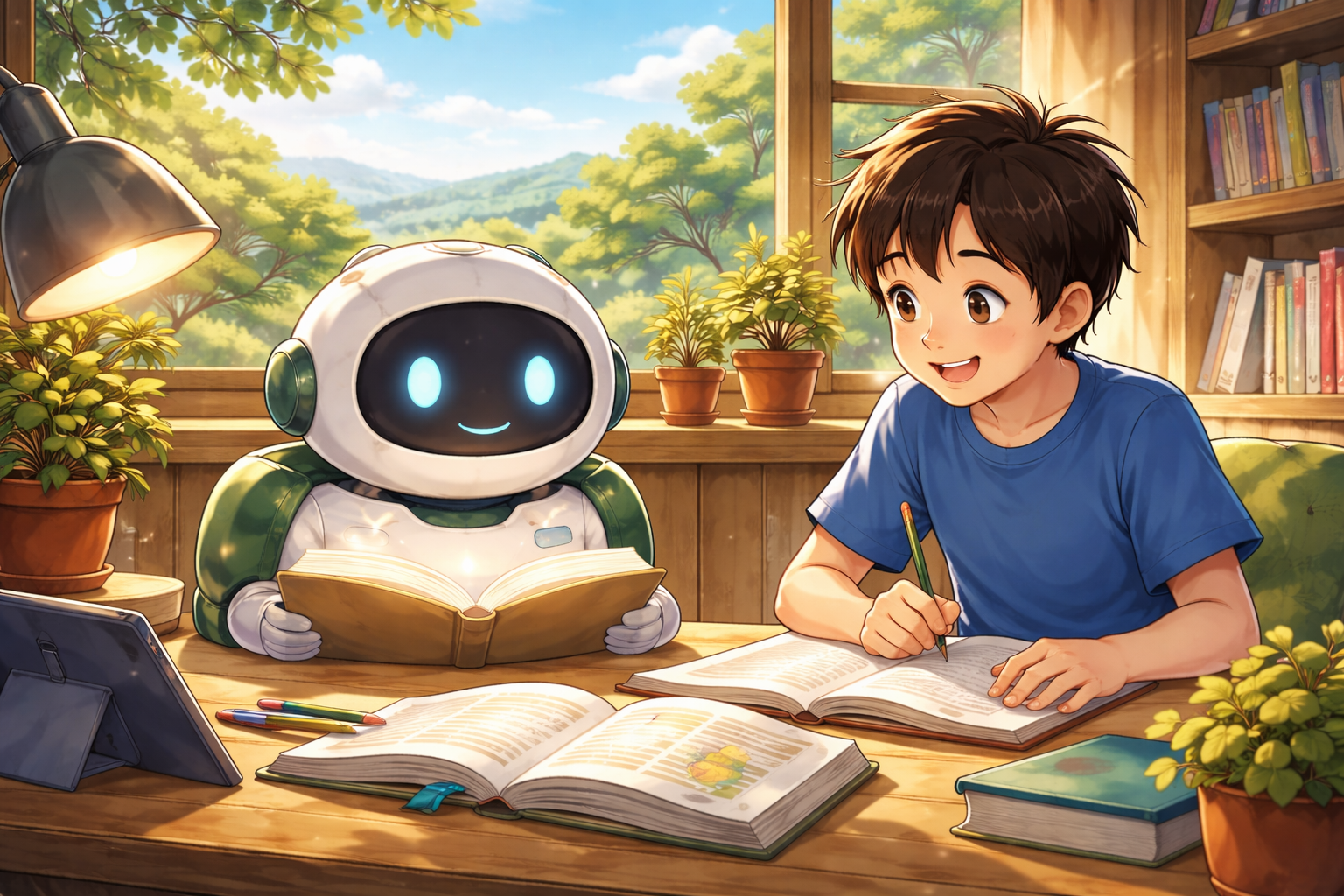
As AI becomes more common, many parents and teachers are asking the same questions: Will AI change how children study? Will memorization matter less? Will homework and essays lose their meaning? AI clearly offers convenience, but it also raises concerns about weaker thinking habits and more copy-and-paste learning. The short answer is yes, AI will change children's learning. But it will not make studying unnecessary. Instead, it will change how children learn and how their learning is evaluated. Based on Japan's Ministry of Education, Culture, Sports, Science and Technology guidelines published on December 26, 2024, along with UNESCO materials from 2024 and OECD materials published on May 23, 2025, this article explains what is changing in practical terms.
Will AI change how children study?
Yes, it will. And the change is not just a short-term trend. It affects the center of gravity of learning itself.
Japan's MEXT document, Guidelines for the Use of Generative AI in Elementary, Junior High, and High School Education Ver. 2.0, does not simply ban or require generative AI in schools. Instead, it lays out principles and cautions for appropriate use. UNESCO's 2024 materials also emphasize the importance of helping children use AI safely and meaningfully, while OECD's 2025 materials ask what teachers should teach and what children should learn in the AI era.
Taken together, these materials suggest a clear shift: the value of learning is moving away from getting answers quickly and toward asking better questions, checking information carefully, and explaining ideas clearly. AI does not end learning. It changes the quality of learning.
The advantages are fairly clear. AI can make it easier to rephrase something a child does not understand, support learning at home, and provide explanations that feel more personalized. The risks are also clear. Children may trust confident-sounding mistakes, look at answers before thinking, or face different rules at school and at home. That is why AI should not be judged only by convenience. It needs to be used differently by age, and the final judgment still belongs to the child and the adults around them.
In practice, the difference is often not whether a child used AI, but whether they thought again after using it. That is where future learning is likely to diverge.
What families can do right now
- Ask children to write their own answer or prediction in one sentence before they ask AI.
- Do not use AI responses as-is. Compare them with textbooks and other materials.
- Make a clear rule at home: AI is for deepening understanding, not replacing thought.
How schoolwork is likely to change
One of the first things to change at school will be the design of homework, essays, and research assignments.
MEXT's Ver. 2.0 guidelines, published on December 26, 2024, organize the key points schools should consider depending on the situation and purpose of AI use. These include handling personal information, respecting copyright, watching for bias and misinformation, and preserving the teacher's role in final judgment.
Once AI can generate plausible text in a very short time, assignments that ask students simply to "research and summarize" become harder to use as they were before. That does not make assignments meaningless. It changes what should matter more. Comparison, verification, evidence checking, and explanation in the student's own words become more important. Teachers may need to look not just at how polished the final submission is, but at the student's reasoning process and how well they can explain the basis for their answer.
There are clear benefits. AI can help with class preparation, support students who need explanations phrased differently, and lower the barrier to inquiry-based learning. At the same time, schools will need to manage copying and overreliance, handle differences in policy from one school to another, and rethink how student work is assessed. The key caution is not to judge academic ability only by the polish of the submission. Schools also need clarity about whether AI was used, how much it was used, and how to preserve the value of textbooks and primary materials.
Even in day-to-day observation, once AI enters the picture, the ability to revise, question, and improve what appears on the screen becomes more visible than the ability to write from a blank page. That is a demanding shift, but it may also reward students who genuinely think more carefully.
What schools and families should watch for
- Ask children to explain whether and how they used AI.
- Check not only writing quality, but also evidence and understanding.
- Design assignments so students can explain why they think what they think.
What abilities will matter most for children?
UNESCO's 2024 AI competency framework for children helps clarify this point.
It emphasizes areas such as human-centered thinking, AI ethics, AI technology and applications, and AI system design. In other words, what matters is not just whether children can use AI tools. What matters is whether they can understand AI, interact with it appropriately, and use it responsibly.
This applies beyond school grades. In learning at home as well, the abilities likely to grow in value are the ability to form questions, compare multiple pieces of information, explain something clearly to another person, and recognize the limits of AI. On the other hand, if children get used to skipping their own thinking just because answers come quickly, their understanding can become shallow even if they appear efficient on the surface.
The benefit of this perspective is that it helps identify the kinds of foundational abilities that still matter in the AI era. It also makes it easier to think about learning as more than just digital tool use. The difficulty is that these abilities can be hard for parents to measure, hard to tie directly to test scores, and somewhat abstract at first. For younger children in particular, adult support remains important. Ethics and safety also need to stay in the conversation, rather than being treated as side issues.
In practice, children often find AI's confident tone persuasive. That is exactly why it matters to build the habit of asking, "Is this really true?" and "Is there another way to say or understand this?"
Skills worth building at home
- The ability to express their own thoughts first
- The ability not to accept AI answers uncritically
- The ability to compare and judge information
- The ability to explain understanding in their own words
Will AI make memorization unnecessary?
This is one of the easiest points to misunderstand.
Based on the government and international materials that can be confirmed at this point, none of them suggest that basic knowledge becomes unnecessary just because AI exists. If anything, OECD's May 23, 2025 materials argue that even in light of AI's progress, we need to rethink what should continue to be learned as a foundation. The question is not whether all memorization becomes meaningless. The question is what knowledge should still remain part of the base.
If children use AI without basic knowledge, they have a harder time judging whether an answer is accurate, misleading, or simply wrong. In history, science, English, and math, even a minimum level of understanding helps students notice when an explanation is weak or mistaken. In that sense, the more useful AI becomes, the more the gap may widen between children who have a foundation and those who do not.
The positive side is that AI can help shift education away from memorization alone and toward deeper understanding and application. The risk is that people jump too quickly to the idea that memorization no longer matters. A more balanced view is better: do not downplay basic knowledge, do not hand too much over to AI, and do not treat foundation and application as the same thing.
In practice, one of AI's best uses is helping students enter a topic from zero. But the final thing that matters is still the learner's own understanding. AI can help with the doorway. It cannot fully replace what happens after walking through it.
A practical way to think about memorization and AI
- Learn basic terms and basic calculation skills directly.
- Use AI for explanation, rephrasing, and support.
- Do not treat memorization and thinking as opposites.
How AI can be used for study at home
At home, AI can be genuinely useful.
It works especially well as an entry-point support tool: rephrasing a difficult unit, organizing the structure of a composition, reviewing an English writing assignment, or helping a child find a starting angle for an independent project. At the same time, MEXT's guidelines also emphasize privacy, copyright, and information security. That means families should set simple but firm rules around not entering names, school names, faces, grades, or sensitive family information.
The most effective pattern at home is usually not "have AI create the answer from the beginning," but "think first, then use AI to review and expand." For example, with a book report, the child can first write what they felt. Then they can ask AI how to improve structure or wording. In math, instead of asking for the answer immediately, they can explain where they got stuck and ask for a hint about how to think through the problem. In that order, AI is more likely to deepen understanding without increasing dependence.
The benefits are practical. Children have another source of explanations, parents do not need to teach everything themselves, and students who struggle with a subject can get a gentler entry point. The drawbacks are also practical. AI can encourage passive use, make copy-and-paste behavior tempting, and leave parents unsure how their child is actually using it. That is why it helps to decide in advance when AI can be used, what it can be used for, and how the child will return to their own words afterward.
In home learning, AI often works better when it is treated not as a tool to make studying easier, but as a tool to reduce the size of the child's stumbling block. That way of thinking usually leads to healthier use.
Tips for using AI at home
- Let the child try first on their own.
- Use AI next to expand, review, or clarify.
- Have the child restate the result in their own words at the end.
- Never enter personal information.
- Avoid long, unfocused sessions.
Should AI be used differently by age?
Yes. The answer changes quite a bit by developmental stage.
It is too simplistic to say either "AI is too early for children" or "the sooner they get used to it, the better." Looking at MEXT's approach and UNESCO's framework, age-appropriate use matters.
For younger elementary school children, using AI together with an adult is usually safer than having them use it alone. At that stage, it makes more sense to use AI for expanding vocabulary, asking questions, and talking through ideas than for producing correct answers. From upper elementary through junior high, AI becomes more practical for research, revision, and comparison. In high school, the range of meaningful use expands further into inquiry projects, argument writing, career exploration, and language learning.
The benefit of adjusting by age is that it makes it easier to match use to the child and reduce unnecessary dependence. The difficulty is that household rules can become more complex, supervision takes effort, and age alone is not a complete guide. Personality, academic level, and self-management all matter too. Siblings also do not need identical rules. The younger the child, the more shared or supervised use should be expected.
At this point, there is no single detailed official standard that assigns exact rules to every age. That is why the most realistic approach is to look at school policy, the child's maturity, and the family's actual situation, then choose a reasonable level of use.
A rough age-based guide
- Younger elementary students: use it briefly and together with a parent or guardian.
- Upper elementary and junior high students: focus on verification and comparison.
- High school students: add source checking, argument structure, and independent judgment.
Summary
AI will change how children study. But that does not mean studying itself will become unnecessary.
Based on MEXT's Generative AI Guidelines Ver. 2.0 published on December 26, 2024, UNESCO's 2024 materials, and OECD's May 23, 2025 materials, what is likely to matter more from here is not how fast children receive answers. It is how well they can ask questions, verify information, and explain what they understand.
For families, the most practical conclusion is simple: AI can be used, but it should not replace the child's own thinking. Think first. Use AI second. Check and rephrase at the end. If that order is preserved, AI becomes less of a shortcut and more of a support for deeper learning.
One simple place to start is this: before asking AI, ask the child to write their own answer in one sentence.
In a time when uncertainty is high, AI is not necessarily a tool that takes learning away from children. Used well, it can be a practical tool that makes differences in thinking more visible and makes good learning habits even more important.